

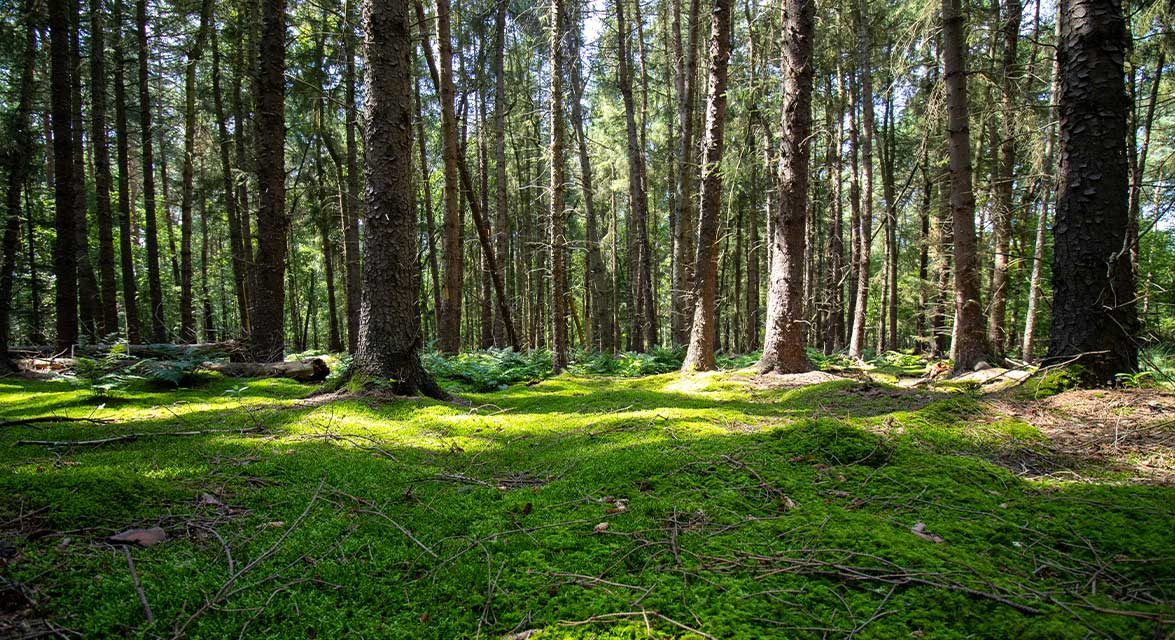
As autumn arrives and the leaves begin to fall, an important new phase begins in the forest: the planting season. Between November and March, forestry workers plant young trees, thereby laying the foundations for the forests of tomorrow. Interforst GmbH, part of the Brüning Group since 2023, is also busy during this period. Around 100,000 trees are earmarked for planting in 2026.
THE FOUNDATION FOR RESILIENT FORESTS
In principle, forests can regenerate naturally without any human intervention. New trees can grow from dispersed seeds, allowing forest stands to regenerate on their own. However, natural regeneration is not always sufficient. Damaging events such as storms or severe bark beetle infestations can result in large clear-cut areas. Targeted planting is also used to support the forest stand where natural regeneration has not been sufficient after several years. Another important reason is climate-adapted forest restructuring: many tree species commonly found in our forests are coming under pressure due to rising temperatures and longer dry spells. This is why mixed forests containing different tree species suited to their specific locations are increasingly being established. Alongside native species, trees that are better adapted to warmer and drier conditions are also being planted, such as red oak, sweet chestnut, and Lebanon cedar. The aim is to establish a greater diversity of tree species and age groups across the same area in the future. This strengthens the forest’s resilience to the effects of climate change and individual damaging events.
FROM SEEDLING TO FOREST OF THE FUTURE
Planting itself requires a great deal of manual work: depending on the site and soil conditions, each employee plants around 400 to 600 young trees per day, most of which are between 15 and 50 centimetres tall. However, the work does not end once the trees have been planted. The young plants require particular attention during their first few years. One challenge is browsing by wildlife. To prevent roe deer and other animals from damaging the young trees, larger areas are often fenced off. This can add up to several kilometres of protective fencing. In addition, competition from other vegetation must be controlled. For this reason, the areas are regularly maintained during the first five years. This process, known as young-stand tending, involves cutting back vegetation around the newly planted trees to ensure they have sufficient light, water, and nutrients to develop well. After around five to ten years, the trees have usually grown to the point where protective measures can be gradually removed. The small seedlings have now developed into a young forest stand.
THE FOREST GROWS AND BECOMES A RESOURCE
A sustainably managed forest is monitored and cultivated over many decades. The first thinning operations take place after 20 to 40 years, depending on the forest stand. Individual trees are selectively removed to give others more room to grow and encourage the development of the stand. When and for what purpose the timber can be harvested depends largely on the tree species and its growth. Beech trees can be harvested after around 30 years, while conifers take approximately 40 years, and oak up to 150. The harvested timber is then put to a wide range of uses, from fuel to construction and furniture timber, as well as other material applications. Forest management is therefore always an investment in the future.
FORESTRY SERVICES WITHIN THE BRÜNING GROUP
This is precisely where the work of our team at Interforst GmbH comes in: based in Kirchzell, the company covers the entire forestry value chain, from planting and forest maintenance to timber harvesting, handling, and transport. Around 150,000 solid cubic metres of timber are handled each year, supplying sawmills, wood-based panel manufacturers, pulp producers, heating plants, and combined heat and power plants throughout Germany, among others. In this way, we combine two sides of the same cycle: the establishment and maintenance of forests, and the subsequent use of wood as a renewable raw material. Responsible forest management and timber utilisation are not contradictory: through the targeted maintenance and development of stands, forests can become more resilient to drought, storms, fires, and pests. At the same time, timber is produced that can be used as a renewable raw material for many years or even decades. Through Interforst, the Brüning Group helps unlock this potential and ensure that resources remain available for the long term.